
As people, we love to over complicate things. Sometimes by trying to do what we think is best and make things perfect, we actually do too much. This happens very often with horses and their diets. I myself of guilty of it too, I can’t seem to leave well enough alone and just trust my original research and gut. I feel like I’m always looking for the next best thing to feed my horses. This isn’t necessarily all bad, because we should always be on the lookout for the best thing for our animals! Sometimes when I find something new I want to try, I just have to do a little mental checklist and ask myself, but do they really NEED this nutritionally?
The way horses should be fed can run down a little check list. So I’ll explain the key points on that list, and how I prepare their diet based on it. I am NOT a nutritionist, but I do find it very important to educate myself on the subject for the benefit of my horses. In this blog post you will find what works for my horses, so please remember that each horses diet needs to be measured and calculated appropriately.
Forage
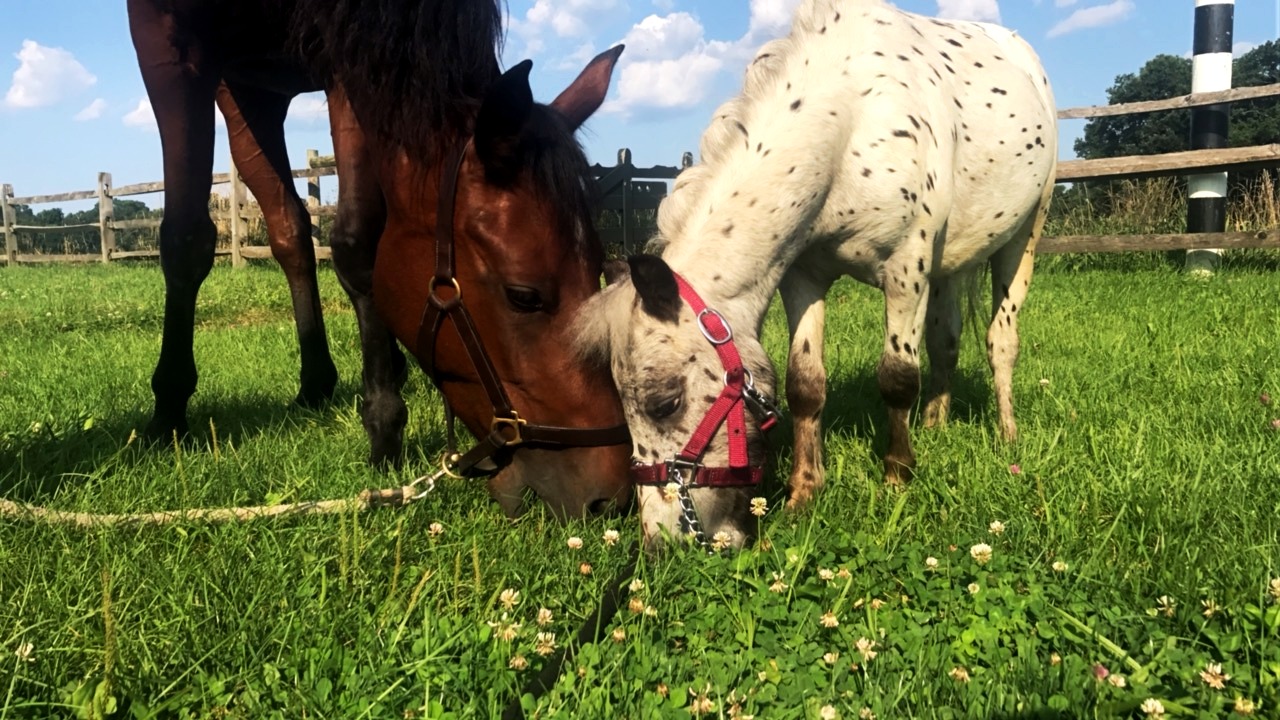
A horses diet should come from primarily forage materials. They are biologically designed to be out grazing on grass all day long. We generally think of two main types of forage – grass and hay. This is pretty obvious to just about anyone who handles horses, BUT not everyone knows exactly how or why. I’m not going to go into too much detail on the why, but at the end of this post you will find a great reference book that really helped me learn about feeding horses that can explain this all to you if you are interested. I will, however, explain a little bit about how to feed forage which bring us to our first check point.
Grass
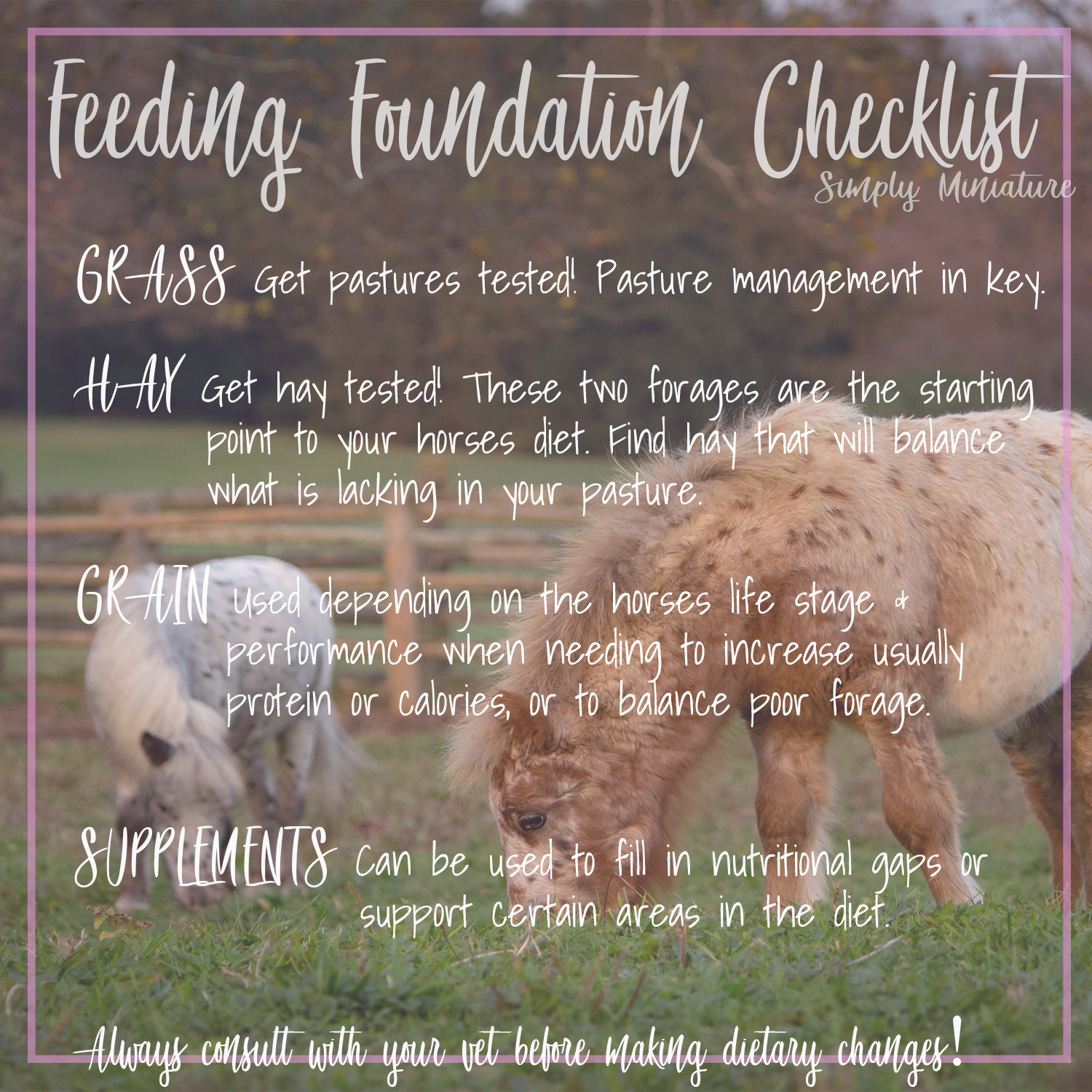
The very first thing you want to look at is the pasture your horse is out on. Getting your pasture tested is going to be the very first step to learn nutritionally what they are getting out of it. Not all grass is the same! The area you live in and the time of the year is going to greatly impact how you feed your horse, because the plants they eat get their nutrients from the soil they are grown in. Depending on the nutrients in your soil, your grass could be higher or lower in different nutrients for the horse. One of the biggest things we look at (especially for the minis) is sugar and starch. The amount of sugar and starch in your pasture is even impacted on the time of the day, because plants release those sugars at different times. Getting multiple samples for nutritional value testing can be very important because of this.
Another factor that greatly impacts the quality of your grass is weeds. A weed is any plant that grows somewhere we don’t want it to. There are many, many different weeds that can inhabit our pastures and they can really be a huge pain, especially when left to take over. Weeds actually choke out the good grasses we want our horses to eat and make it very hard for them to grow. To make matters worse they can be stubborn and hard to kill. It’s important to identify which weeds are in your pasture and learn how to get rid of them. This is all apart of pasture management! If you are unfamiliar with pasture management practices I urge you to do more research on the subject.
Getting your grass tested is easy. If you live in the U.S. contact your local county extension office for more information on how and when to collect a sample and where to send it to. Once you get your results, and you’ve done your research on what you’re actually looking at, how to read it, and what values you want.. you can then decide if there is anything you can do within the pasture management realm to change things or if this is going to be the foundation to your feeding schedule.
I personally have not had the grass that my horses go out on tested. They are currently boarded at a barn I do not own, so even though I could (and plan to at some point in the future) have it tested on my own, it just hasn’t been done. Even though I’m slacking on the first check point… don’t be like me. Get your grass tested! I do however know that the pastures have a very high weed volume currently so I know there is not as much grass as there may appear to be, and the grass that is out there is probably pretty high in sugar. When we see a pasture with very little grass in it we might think “Oh good, my horse can’t gorge themselves and get fat on that pasture.” when really, the more stressed the grass is, the more sugar it retains. So the only concrete way to know what our horses are dining on out there, is to get those test results! Once again, your local county extension agent is going to be a great resource for more information on pasture management and analysis.
Hay
After getting your pasture results and determining how much of your grass your horses can eat and what needs to be balanced you can move on to check point number two and begin to find the right hay to balance out that diet. The great thing about hay is just like grass, its not all the same. Hay also needs to be tested in order to know what the nutritional value is. You may be able to get hay from a distant location that is going to make up for what ever nutritional gaps your pasture has, and then again you may not.
I am very fortunate enough to live in a heavily horse populated area with many hay producers around. The hay I am buying right now is what I really use as my foundation since I do not have pasture values. Since I am using only those results I wanted to make sure it is really balanced in all of the right places. My supplier has all of their hay results available for me with made things super easy, after the agonizing task of learning how to read a test result.. which I always need a little brushing up on before doing, so don’t feel overwhelmed when you first look at those results. I feed a grass hay and an alfalfa hay at about a 3:1 ration. I do not weigh my hay because my horses have unlimited forage! They are either out in the pasture, with or without hay depending on the season, or in the stall with all of the hay they could possibly want. They have three slow feeds in their so I know they will not run out. There is some debate on feeding horses this way, but I am all for it. This is how they are biologically designed to eat, provided the proper forage to eat they will remain healthy doing so. Fasting your horse cannot only cause ulcers, but also puts them in this cycle of ravenously eating when they get food and then just standing around waiting for more when they’ve finished. Two things horses are not designed to do! When my boys are in they periodically eat because they know it’s always going to be there, they do not need to gorge themselves when given a meal. They are also provided with lots of other things to do in their stall to help keep things interesting as well as having each other to nap or goof off with in between grazing periods. For more information check out my blog post about the slow feeders I use here.
The biggest things to remember about forage is that it is the foundation to your horses diet, not all grass and hay is the same, and that getting them tested is the only way to truly know what your horse is actually eating. Once you have the numbers down on what your horse is digesting, you can move onto the third check point.
Grains
There is so much to learn about when, why, and how to feed grains to your horse. Like I said before, I am not a nutritionist so I will not go into all of this but only where it applies to Jasper and Wallace. Grains are primarily used when horses are in different life stages. Since my boys are both growing babies, they need more protein and calories. This is where I supplement their forage with grain, specifically a ration balancer. I’ve gone through a couple of different grains until I found ProAdvantage Grass Formula ration balancer and haven’t looked back since. I really like this balancer for a few reasons. First, it is concentrated so the total volume you feed is much less than most commercial grains. Horses are designed to eat many small meals all day long, and over feeding them too many processed grains can be pretty dangerous to their health. Secondly, it has a low starch/sugar content so it’s good for my little minis who really need those sugars kept as low as possible. Balancers usually have a very high protein percentage since they are concentrated so that’s another good quality.
One of the most important things, besides making sure its nutritionally appropriate, about grains is to feed the recommended amount for your horses age, weight and performance. Also, do not mix different commercial feeds together. They are formulated and calculated the way they are for a reason, and you can just make a mess of your nutritional values doing this. If you go through all three of the check points with the best resources available to you, and are still off or lacking in some department then you can begin looking at supplements.
Supplements
We all know there are a million and one supplements available for our horses. Do not just go buying them all! You can really mess up the work you’ve already put in and waste a lot of money. Supplements are meant to support and fill gaps in the diet, not become another food group.
The only “supplement” I add to their feed, which isn’t even really a supplement but I’m going to fit it in here, is ground flax seed. I feed this to balance the omegas that is unbalance in their diet. Most commercial grains do not properly balance omegas so watch out for that. I’ve messed with a couple supplements in the past but found we really do not need them right now. That could always change. Diets change!! but for now, their diet is pretty simple.
To really feel more secure that my horses have all they need, I provide them with a free choice loose vitamin and mineral supplement as well as free choice loose salt. This way they have it if they need it, but I’m not over doing anything if they don’t.
Marketing strategies will tell you that your horse needs this or that to have the shiniest coat or the soundest hooves but don’t let them fool you. A horse with a properly balanced diet most likely does not need these extra supplements and you will waste a ton of money on feeding them things their bodies are already getting. Always do your homework when trying to decide what supplements to use and consult with your vet.
Review the Checklist:
So that was a lot and was pretty vague. The purpose of this blog was really meant to be a jump start/quick guide line for you do to more research and build your own horses diet. Remember that a diet is always going to be changing – your forage might change with the season, your horses requirements might change, your supplements might need to change, it all can change at some point. So make sure your regularly checking in and monitoring your horses health. You can use this list in this order to make sure your hitting all of the key points! Always consult with your vet when making changes and reach out to someone who specializes in equine nutrition for a consult if you are struggling to come up with a proper feed plan.
If you’re looking to learn more about equine nutrition I highly recommend Feed Your Horse Like A Horse by Juliet M. Getty. This book has been my main resource for learning how to formulate my own horses diet. I’ve learned a lot and often refer to it when checking in and monitoring Jasper and Wallace’s feed. There are plenty of other books and articles on the web, just make sure you are getting your information from a credible source.
 The Pony Bunch